Renting your villa for short stays in Morocco: what law 80-14 really says.
Updated on 21 October 2026 · By Mathieu, founder of The Keys Conciergerie · Reading time: 7 minutes
Yes, renting your villa for short stays in Morocco is legal. But it is not unrestricted. Law no. 80-14 and its implementing texts establish three principles: an authorisation before welcoming travellers, the declaration of each person accommodated, and administrative checks. The rest, particularly many figures circulating online, do not appear in the official texts. Here is what the law and its decrees actually say, article by article.
1. Law 80-14 in brief: the text that governs all tourist accommodation
Law no. 80-14 relating to tourist establishments and other forms of tourist accommodation was promulgated by dahir no. 1-15-108 of 4 August 2015. It was published in French in the official bulletin no. 6404 of 15 October 2015. It replaces the former law 61-00.
According to the Ministry of Tourism, it pursues three objectives: to improve the quality of services, to align the Moroccan offer with international standards, and to adapt the classification to the diversity of accommodations.
2. Does your villa fall within the scope of the law?
This is the central question and the answer requires precision.
Article 2 of the law defines a tourist accommodation establishment as a commercial establishment that receives transient or staying clients and provides them with accommodation. Article 3 lists nine categories: hotel, club hotel, tourist residence, guest house, riad, kasbah, gîte, boarding house and camping.
Article 29 adds the "other forms of tourist accommodation": bivouacking, accommodation with locals and alternative accommodation. Accommodation with locals targets an individual who welcomes tourists, as a family, in the dwelling where they themselves reside.
What the law does not expressly state: it does not mention either Airbnb or the "furnished tourist rental" of an entire villa. The classification of your property therefore depends on concrete criteria: the habitual and commercial nature of the activity, the services offered to travellers, and whether you reside there or not.
3. The concrete obligations of the owner:
1. Obtain permission before welcoming. For other forms of accommodation, Article 30 makes operation conditional on obtaining permission accompanied by a specifications document. Decree 2-23-441 specifies that this permission falls under local authorities, after consultation with the relevant services. For classified establishments (riad, guest house), the decree provides for electronic submission of the file to the Regional Investment Centre.
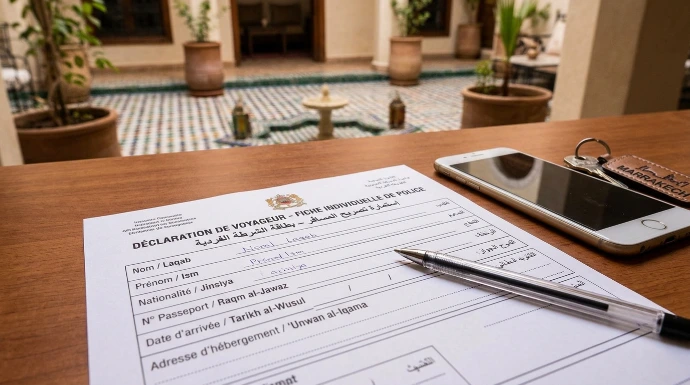
2. Declare each traveller. Articles 36 and 37 of the law impose the declaration of arrivals and overnight stays. Decree 2-15-865 organizes this declaration online, with an individual accommodation form for each traveller. The obligation rests with the host, not with the booking platform.
3. Accept inspections. Article 31 states that other forms of accommodation are monitored by the administration for the entire duration of their authorisation.
4. Be transparent with travellers. The law requires operators to honour confirmed bookings, clearly display prices, and provide an invoice detailing the services.
4. Four misconceptions to correct
" Airbnb is banned in Morocco. " False. No text prohibits short-term rentals. They are regulated, not banned.
" In Marrakech, you can only rent for 120 days a year. " This figure circulates on many sites, without ever citing a specific article. Before considering it, demand the exact reference of the text.
" The fine is X dirhams. " The amounts published online vary from simple to tenfold depending on the sources. Only the text of the law is authoritative: consult it or have it read by a professional.
" The platform declares the travellers on my behalf. " No. The declaration remains an obligation of the host.
5. The Keys Concierge approach : compliance before the first booking
In Marrakech, trust is easily lost. Our position is simple: no property is listed online until its legal framework is clear.
What to remember when you entrust us with your villa:
- We check the framework above all. Property status, authorisation, documents: we review everything with you before the first listing.
- We declare each traveller upon their arrival. Without exception, regardless of the length of stay or nationality.
- We work transparently. Clear rates for travellers, monthly reporting for you.
- We guide you to the right professionals. For taxation or administrative procedures, we connect you with local experts.
You remain the owner of your choices. We orchestrate the daily routine, within the rules. Discover our support.
Frequently asked questions
1.Is short-term rental legal in Morocco? Yes. It is regulated by law 80-14 and its implementing texts, which require authorisation and the declaration of travellers.
2.What is the implementing decree of law 80-14? The main one is decree n° 2-23-441 of 13 July 2023. It sets the procedures for authorisation and classification.
3.Do I need to declare Moroccan travellers? The law applies to all persons accommodated. Each arrival results in an individual accommodation report.
4.Who issues the authorisation for other forms of accommodation? The local authorities, after consultation with the relevant services, according to decree 2-23-441.
5.Where can I read the official texts? On the Tourist Accommodation page of the Ministry of Tourism's website, which makes them available for download.
This article is informative and does not constitute legal advice. The texts cited are those published by the Ministry of Tourism at the date of update. For your personal situation, consult a legal professional.